

Excavation vs Grading vs Site Prep: What’s the Difference?
These three terms get used interchangeably, but they mean different things. Excavation is moving dirt. Grading is shaping it. Site prep is the whole sequence that gets a piece of land ready for whatever’s next. Understanding the difference helps you get accurate quotes, schedule the right work, and avoid paying for something you didn’t actually need.
TL;DR:
– Excavation: Digging out or removing material (dirt, rock, debris) from an area
– Grading: Shaping the ground surface to a specific slope, elevation, or contour
– Site prep: The complete process of getting land ready for construction — includes clearing, excavation, grading, drainage, and more
– Most projects need all three in sequence — you excavate first, grade second, and the whole sequence is called site prep
– Quotes that lump them together can hide what’s included and what isn’t

What Excavation Means
Excavation is the act of removing material from the ground. That material might be dirt, rock, old concrete, tree stumps, debris, or a mix. The key word is “removing” — it’s about getting material out of an area.
Common excavation scenarios:
- Digging a foundation for a house or outbuilding
- Excavating a pond or lake
- Digging trenches for utilities
- Removing a driveway to replace it
- Demolishing a structure and excavating debris
- Digging a basement out
Excavation usually generates spoils — the material that came out has to go somewhere. Spreading it on site, hauling it off, or stockpiling it for later use are all part of the job.
When you hire someone for “excavation,” you’re usually hiring them to remove material from a specific area. That’s it. Finishing the surface, setting a grade, or preparing for construction is separate work.
What Grading Means
Grading is shaping the ground surface. It’s about creating a specific elevation, slope, or contour. The ground might be left exactly where it is — grading is often just rearranging what’s already there.
Common grading scenarios:
- Leveling a building pad before foundation work
- Creating positive drainage away from a structure
- Smoothing a site after clearing or excavation
- Shaping a driveway slope
- Setting final contours for landscaping
- Crown and slope for water management
Grading works with existing soil to achieve a target shape. It’s finer work than excavation — you’re not just moving material, you’re placing it precisely.

Rough Grading vs Fine Grading
Even within grading, there are stages:
Rough grading gets the site to within a few inches of the target grade. This is usually done after clearing and excavation. Rough grading establishes the big-picture shape — pad elevations, drainage paths, access roads.
Fine grading takes the site from “close enough” to “exactly right.” Used for things that need precise elevation: foundation pads, driveway bases, final lawn surfaces. Fine grading typically happens just before the next trade (concrete, paving, sod).
What Site Prep Means
Site preparation is the umbrella term for everything required to turn raw land into a buildable site. That includes:
- Clearing — removing trees, brush, stumps, existing structures
- Excavation — removing material where it isn’t wanted
- Grading — shaping the ground to design specs
- Drainage installation — culverts, swales, French drains
- Utility trenching — water, sewer, electric, gas runs
- Access road construction — getting equipment and construction traffic to the site
- Compaction and pad prep — making the building area ready for foundation work
Site prep is a sequence. Each step depends on the previous one. Do them out of order and the work gets redone.
Citation capsule: In southwest Missouri, a typical residential site preparation project includes clearing, excavation, rough grading, drainage installation, utility trenching, and pad preparation — usually completed in a 1-2 week window for a standard single-family home site. Doing any of these steps out of sequence commonly requires redoing earlier work, which is the single biggest source of cost overruns on new construction starts.
Why the Distinction Matters
Three real reasons to understand the difference:
1. Quote Accuracy
A contractor who quotes “site prep” should be covering the whole sequence. A contractor who quotes “excavation” is only covering material removal. If you needed the whole job done and only paid for excavation, you’ll pay again for grading, drainage, and pad work.
When comparing quotes, check what each one actually includes:
- What’s the scope? Clearing? Excavation? Grading? All of the above?
- What’s the endpoint? Rough grade? Fine grade? Ready for foundation?
- What’s NOT included? Permit fees? Utility tie-ins? Landscaping?
2. Scheduling
Site prep is the first trade on a construction project. It has to be complete before concrete, framing, or anything else starts. Understanding the sequence helps you see where delays can stack up.
A typical schedule:
- Week 1-2: Clearing and rough excavation
- Week 2-3: Rough grading and drainage
- Week 3: Utility trenching (often parallel with grading)
- Week 3-4: Fine grading and pad prep
- Week 5+: Foundation and framing begin
Skip or compress a step and the later trades suffer. Rush the pad prep and the concrete guys spend a day fixing it. Skip drainage and you pay for it in year three when the basement gets wet.

3. What You’re Buying Long-Term
Site prep isn’t glamorous. Nobody sees it once the house is built. But it’s the single biggest factor in whether the structure performs well for decades.
A house built on a well-prepped site:
– Has a dry basement or crawlspace
– Doesn’t develop foundation cracks
– Drains water away properly
– Has a usable yard
– Maintains its grade over time
A house built on poorly prepped site:
– Develops water problems
– Settles unevenly
– Has drainage issues that never really go away
– May need expensive foundation repairs within 10-20 years
The dirt work is the part nobody wants to pay for because they can’t see it in the finished product. It’s also the part that matters most.
How the Three Fit Together: A Real Example
Let’s walk through a typical SW Missouri project: building a 2,000 sq ft home on a rural 5-acre lot with some mature trees.
Clearing (2-3 days): Remove trees and brush from the building envelope and access road. Haul or burn debris.
Excavation (2-3 days): Dig the basement/crawl space area. Remove topsoil and stockpile it for later. Cut access road into the site.
Rough grading (1-2 days): Shape the yard to direct water away from the foundation. Establish the driveway slope. Create the basic contour of the finished site.
Drainage and culverts (1 day): Install the driveway culvert. Dig any subsurface drainage needed.
Utility trenching (1-2 days): Trench from the road for water service, electric, and any other underground utilities.
Fine grading and pad prep (1 day): Finish the building pad to exact elevation. Compact. Ready for foundation crew.
Total: Roughly 2 weeks of active dirt work. All of it is “site prep.” The excavation and grading are specific tasks within it.
Who Does What
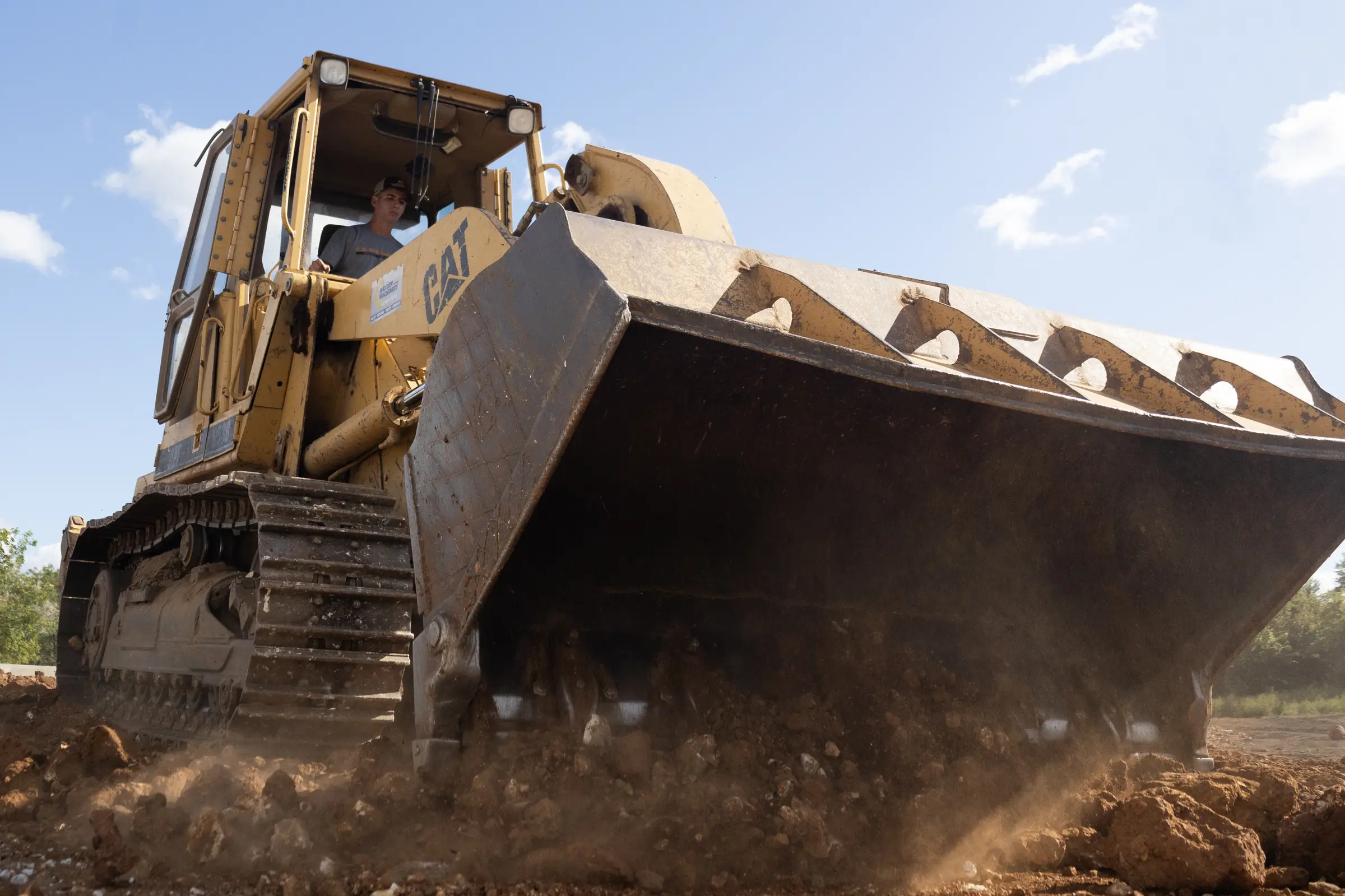
On most projects, a single excavation contractor handles clearing, excavation, grading, drainage, and trenching. Then specialists come in for concrete, plumbing, electric, HVAC. The excavator is the first trade on site and often the first to return at the end of the project for final grading and yard restoration.
Calvin Smith Excavating handles the full site prep sequence for residential and small commercial work across SW Missouri. That means you have one contractor managing clearing through final grade — so nothing falls between trades.
Call (417) 719-0643 to walk through your project.
Frequently Asked Questions
What’s the most expensive part of site prep?
It varies by site. On rocky properties, excavation through rock is the biggest line item. On heavily wooded lots, clearing and debris handling. On properties with drainage challenges, the drainage design and installation. For typical SW Missouri residential sites without major obstacles, clearing and rough grading are usually the biggest costs.
Can I do some site prep myself to save money?
Usually not worth it. Site prep quality compounds through the rest of the project — a DIY rough grade that’s off by 6 inches means the foundation crew’s work is harder, and your final result is worse. For most homeowners, hiring the whole site prep out is cheaper long-term than DIY work that has to be redone.
How long before construction should site prep happen?
Ideally, site prep completes 1-2 weeks before the foundation work starts. That gives the ground time to settle and any rain-related issues to show up before the concrete is poured. Some projects compress this window for schedule reasons, but it’s worth leaving time if you can.
Do I need a permit for site prep?
For most residential projects, the building permit covers site prep as part of the overall project. Clearing, grading, and excavation on your own land usually don’t need separate permits unless you’re in a floodplain, near protected waters, or in a subdivision with specific rules.
What happens if the site isn’t prepped right?
Usually one of three things: you pay to fix it before proceeding, you proceed and hope for the best (often regretting it later), or you discover the problem when the foundation cracks or water intrudes. The cheapest moment to address site prep is before concrete gets poured. After that, every fix gets more expensive.
Calvin Smith Excavating handles the complete site prep sequence across SW Missouri — clearing, excavation, grading, drainage, and pad prep. (417) 719-0643.